
In different operating environments, different accumulator materials should be selected.
Since the working medium of accumulators is generally oil and the pressure resistance requirement is relatively high, carbon steel is an economical and practical choice. Carbon steel accumulators can meet the needs of the vast majority of working conditions.
When encountering corrosive environments or corrosive media, Milehertz can provide accumulators made of stainless steel. Stainless steel can be further divided into 304, 316L, 2205, etc. The most cost-effective accumulator should be selected according to actual working conditions and price.
304 stainless steel is generally used in mild environments where the medium is ordinary industrial water or non-corrosive hydraulic oil;
316L stainless steel is the most commonly used and can be applied to most industrial hydraulic oils, water-glycol fluids, and water with a certain chloride content. Its pressure resistance performance is also better than that of 304 stainless steel.
2205 stainless steel has better resistance to chloride corrosion and is usually used in harsher environments, such as seawater, high-chloride media, oilfields containing H₂S, and chemical processes. At the same time, due to its high strength, the pressure vessel wall can be thinner, but the price is also higher.
2507 stainless steel, also known as super duplex stainless steel, can be used in extremely corrosive environments: ultra-high-temperature seawater, strongly oxidizing acids, and high-concentration chlorides, such as offshore platforms, desulfurization units, and special chemical processes.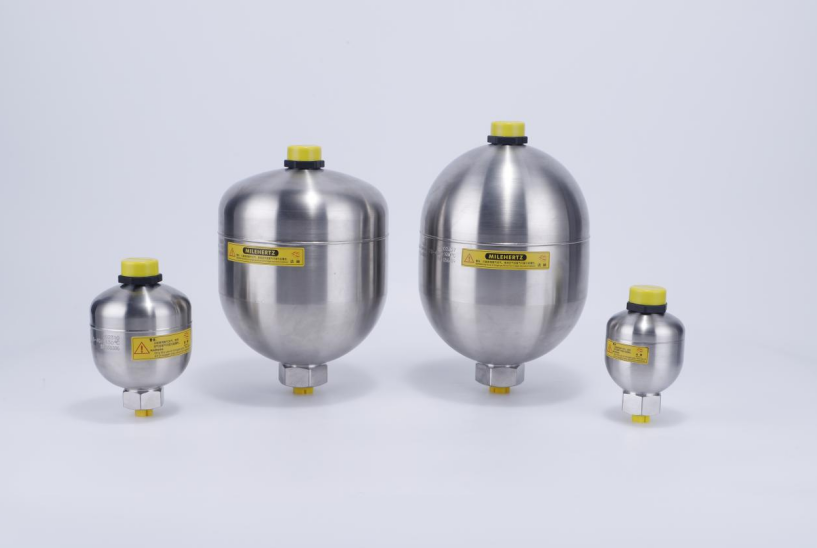
Select different accumulator materials according to the operating environment.
When stainless steel is required, 316L can meet the needs of most environments. When the environment is more severe, 2205 or the higher-grade 2507 should be selected. For relatively mild environments where economic efficiency is a priority, 304 stainless steel can be chosen.



No.1 Yingxin Second Road, Xikou Town, Ningbo, China.

Phone: +86-13858356336

E-Mail: sales@milehertz.com
© 2026 Ningbo Milehertz Machinery Co., Ltd. All rights reserved. Hydraulic Accumulator Manufacturer Hydraulic Accumulator Factory


 English
 русский
 Español
 中文简体
中文简体